


Home
/
Blogs
/
Hair Growth
/
Your First 90 Days with the Lumigrow Cap
5 min read
Your First 90 Days with the Lumigrow Cap: What to Expect Week by Week
You've bought a red light therapy cap. You've read the studies. Now you're staring at your hairline wondering how long this actually takes.
The honest answer: longer than you want, but shorter than you think. Most clinical trials use a 16-week primary endpoint — and the data at that mark is genuinely encouraging. But the weeks in between can feel slow if you don't know what's normal.
Here's your week-by-week roadmap.
The honest answer: longer than you want, but shorter than you think. Most clinical trials use a 16-week primary endpoint — and the data at that mark is genuinely encouraging. But the weeks in between can feel slow if you don't know what's normal.
Here's your week-by-week roadmap.
Before you start: document your baseline
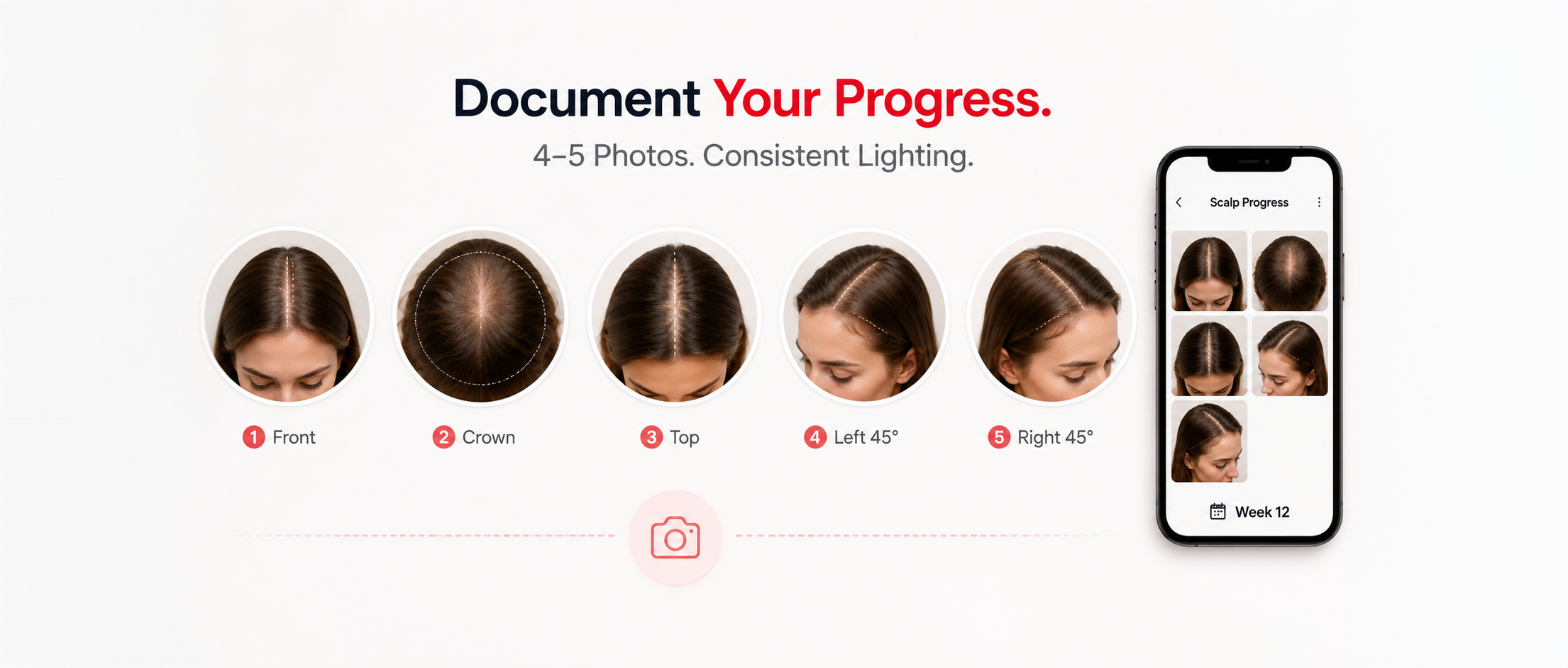
This step is non-negotiable. Take 4–5 photos of your scalp under consistent lighting — overhead bathroom light works, natural window light is better. Photograph your hairline from the front, the crown from above (use your phone's timer and a mirror), and both temples at 45 degrees.
Save these somewhere you won't lose them. You'll thank yourself at week 12 when you're trying to remember whether the thinning was always that filled-in.
Save these somewhere you won't lose them. You'll thank yourself at week 12 when you're trying to remember whether the thinning was always that filled-in.
Week 1–4: The invisible phase
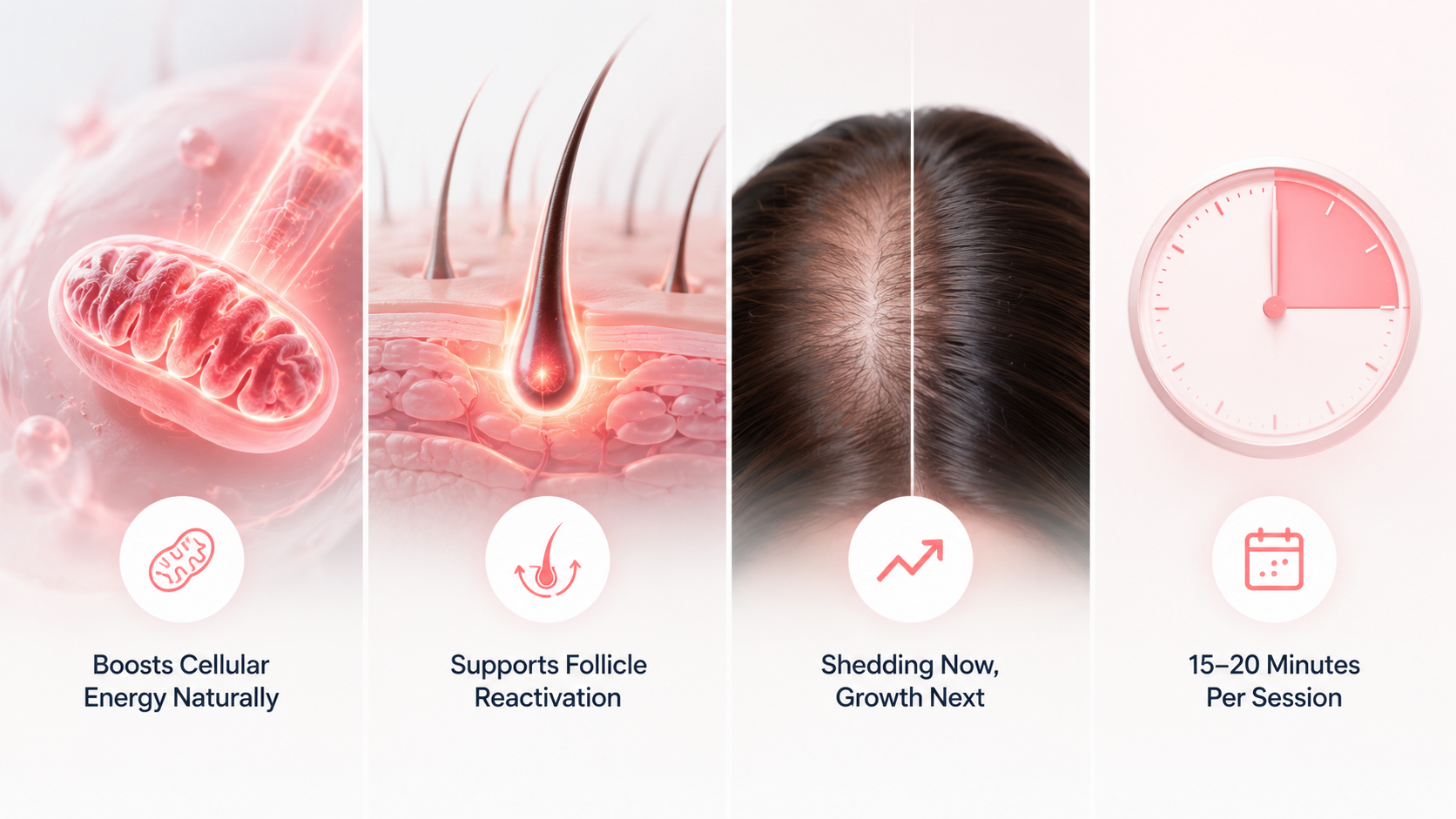
What's happening biologically: The Lumigrow Cap's 630nm and 850nm wavelengths are being absorbed by cytochrome c oxidase in your follicle cells, increasing ATP production and triggering cellular proliferation (Hamblin, 2017). Dormant telogen follicles are beginning to shift toward anagen re-entry. None of this is visible yet.
What you'll notice: Possibly nothing. Some users report a slight tingling or warmth during sessions — this is normal and indicates vasodilation (blood vessel widening) in the scalp.
The shedding question: Some users experience a temporary increase in shedding during weeks 2–4. This is a recognized phenomenon in LLLT treatment — as dormant follicles reactivate and push into a new growth cycle, old telogen hairs are shed to make room. It can feel alarming, but it's actually a positive signal that the follicles are responding. The Lanzafame trials noted this pattern. If shedding persists beyond 6 weeks, consult your dermatologist.
Protocol: 15–20 minutes per session, daily or every other day. Consistency matters more than duration — three 15-minute sessions per week will outperform one 45-minute session (Stanford Medicine).
What you'll notice: Possibly nothing. Some users report a slight tingling or warmth during sessions — this is normal and indicates vasodilation (blood vessel widening) in the scalp.
The shedding question: Some users experience a temporary increase in shedding during weeks 2–4. This is a recognized phenomenon in LLLT treatment — as dormant follicles reactivate and push into a new growth cycle, old telogen hairs are shed to make room. It can feel alarming, but it's actually a positive signal that the follicles are responding. The Lanzafame trials noted this pattern. If shedding persists beyond 6 weeks, consult your dermatologist.
Protocol: 15–20 minutes per session, daily or every other day. Consistency matters more than duration — three 15-minute sessions per week will outperform one 45-minute session (Stanford Medicine).
Week 5–8: The patience phase
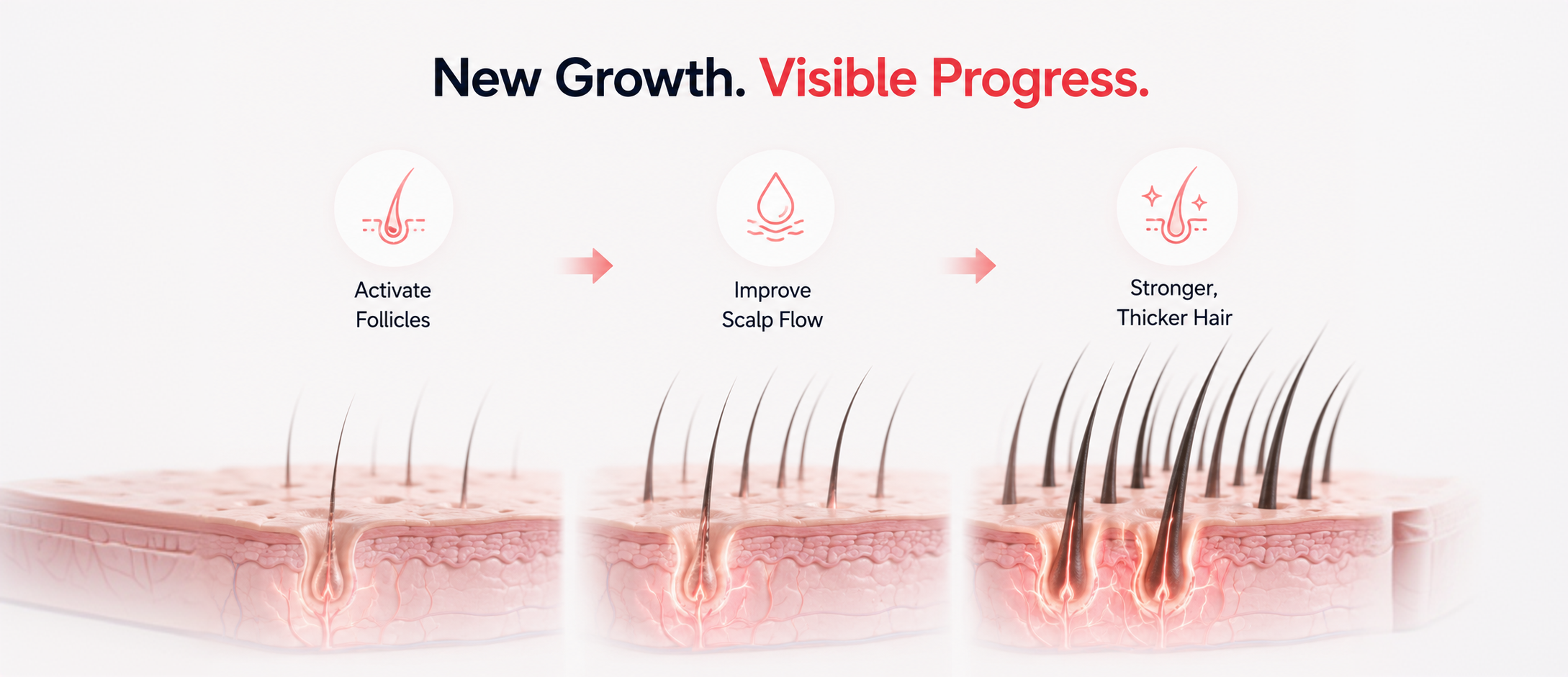
What's happening biologically: New anagen hairs are forming beneath the scalp surface. Follicles that were producing thin, vellus-like hairs are beginning to produce slightly thicker shafts. Blood flow to the scalp has increased due to ongoing vasodilation effects.
What you'll notice: Shedding typically normalizes or decreases. Some users report their hair "feels" different — slightly stronger at the root, less limp. You probably won't see obvious visual density changes yet. This is the phase where most people quit. Don't.
What to do: Keep going. Take your second set of comparison photos at week 8. Compare them side-by-side with your Day 1 photos under the same lighting. You may spot subtle changes you wouldn't notice in the mirror daily.
What you'll notice: Shedding typically normalizes or decreases. Some users report their hair "feels" different — slightly stronger at the root, less limp. You probably won't see obvious visual density changes yet. This is the phase where most people quit. Don't.
What to do: Keep going. Take your second set of comparison photos at week 8. Compare them side-by-side with your Day 1 photos under the same lighting. You may spot subtle changes you wouldn't notice in the mirror daily.
Week 9–16: First visible results
What's happening biologically: This is the primary endpoint window in the clinical literature. The Lanzafame 2013 and 2014 RCTs measured hair count at 16 weeks and found 37–39% increases in the treatment groups versus placebo.
What you'll notice: Reduced visible scalp through thinning areas. Hair may photograph fuller. Less hair in your brush, shower drain, or pillow. Barbers or stylists may comment unprompted — this is often the most reliable early signal, since they see your hair with fresh eyes.
What to do: Take photos at weeks 12 and 16. If you're seeing improvement, you're on the right trajectory. If not, consider adding complementary treatments — the Red Light Scalp Massager for enhanced circulation, or discussing minoxidil with your dermatologist.
What you'll notice: Reduced visible scalp through thinning areas. Hair may photograph fuller. Less hair in your brush, shower drain, or pillow. Barbers or stylists may comment unprompted — this is often the most reliable early signal, since they see your hair with fresh eyes.
What to do: Take photos at weeks 12 and 16. If you're seeing improvement, you're on the right trajectory. If not, consider adding complementary treatments — the Red Light Scalp Massager for enhanced circulation, or discussing minoxidil with your dermatologist.
Beyond 90 days: Maintenance and compounding gains
The clinical data suggests continued improvement beyond 16 weeks with sustained use. A 2025 meta-analysis of FDA-cleared LLLT devices found that devices with higher diode counts and full scalp coverage — like the Lumigrow Cap's 272 LEDs — were associated with the best long-term outcomes.
The critical point: results require ongoing use. As Stanford Medicine notes, when you stop applying red light, the effects stop. Plan to make this part of your routine indefinitely — 15 minutes while you have morning coffee or read before bed.
The critical point: results require ongoing use. As Stanford Medicine notes, when you stop applying red light, the effects stop. Plan to make this part of your routine indefinitely — 15 minutes while you have morning coffee or read before bed.
Pro tips to maximize your results
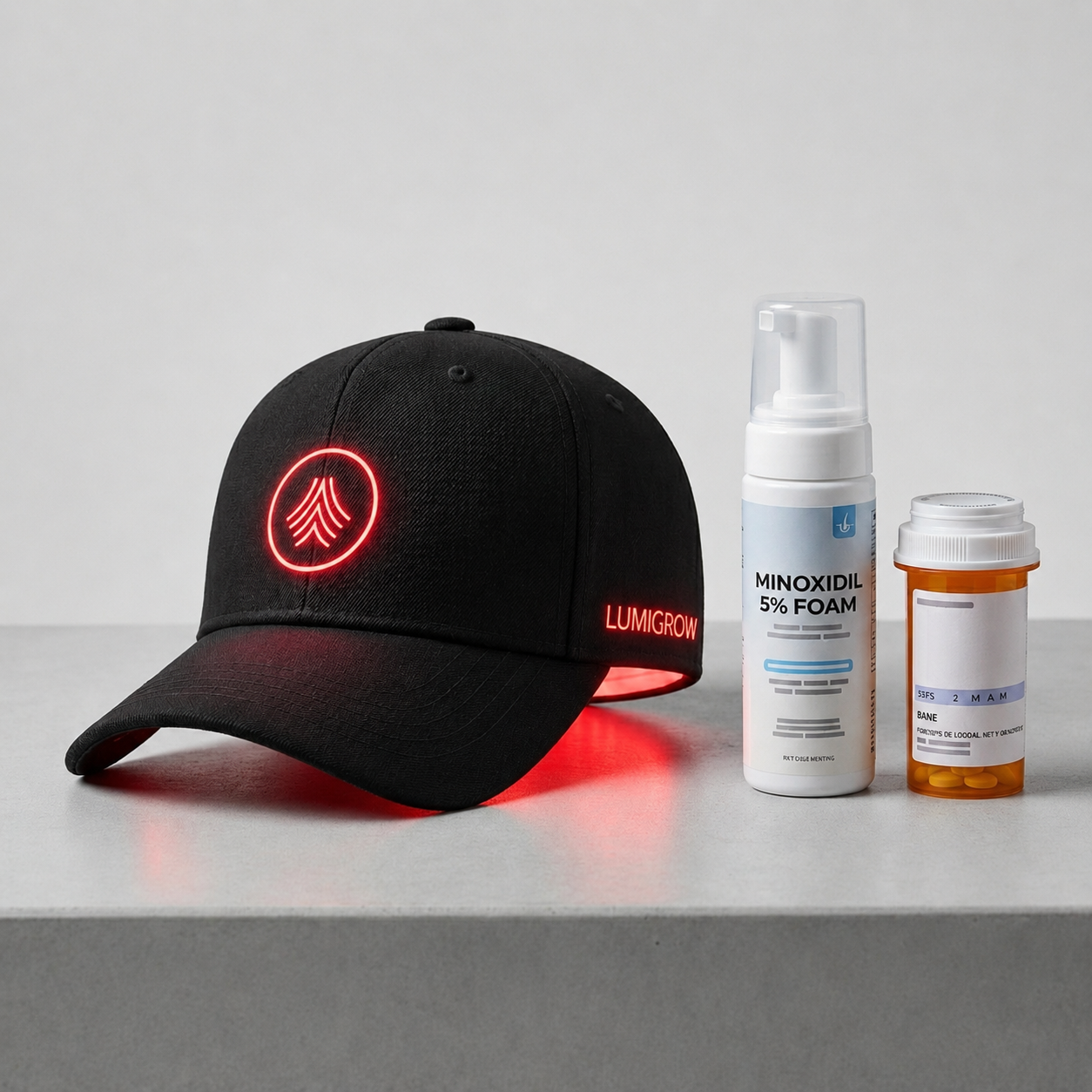
Stack intelligently. LLLT works through photobiomodulation — a completely different pathway from minoxidil (vasodilation) or finasteride (DHT blocking). Combining them gives you three separate mechanisms working simultaneously (Cosmedica).
Don't skip days in the first 90. The clinical trials used every-other-day or daily protocols. Building the habit early matters more than perfect session length.
Clean scalp, better absorption. Use the cap on clean, dry hair when possible. Heavy styling products can partially block light penetration.
Track monthly, not daily. Hair growth is slow. Daily mirror-checking creates anxiety. Monthly photo comparison under consistent lighting gives you real data.
Don't skip days in the first 90. The clinical trials used every-other-day or daily protocols. Building the habit early matters more than perfect session length.
Clean scalp, better absorption. Use the cap on clean, dry hair when possible. Heavy styling products can partially block light penetration.
Track monthly, not daily. Hair growth is slow. Daily mirror-checking creates anxiety. Monthly photo comparison under consistent lighting gives you real data.
Disclaimer
The content provided in this blog is for informational and educational purposes only. It is not intended to be a substitute for professional medical advice, diagnosis, or treatment.
Recent Posts


Browse Related Products

Join The Red Light Reset
Get science-backed skincare insights, expert guides, and early access to new device launches.
No spam. Just clinically-informed education and member-only benefits