

Home
/
Blogs
/
Anti-Aging
/
Can Red Light Therapy Actually Reduce Wrinkles?
5 min read
Can Red Light Therapy Actually Reduce Wrinkles? Here's What the Research Says
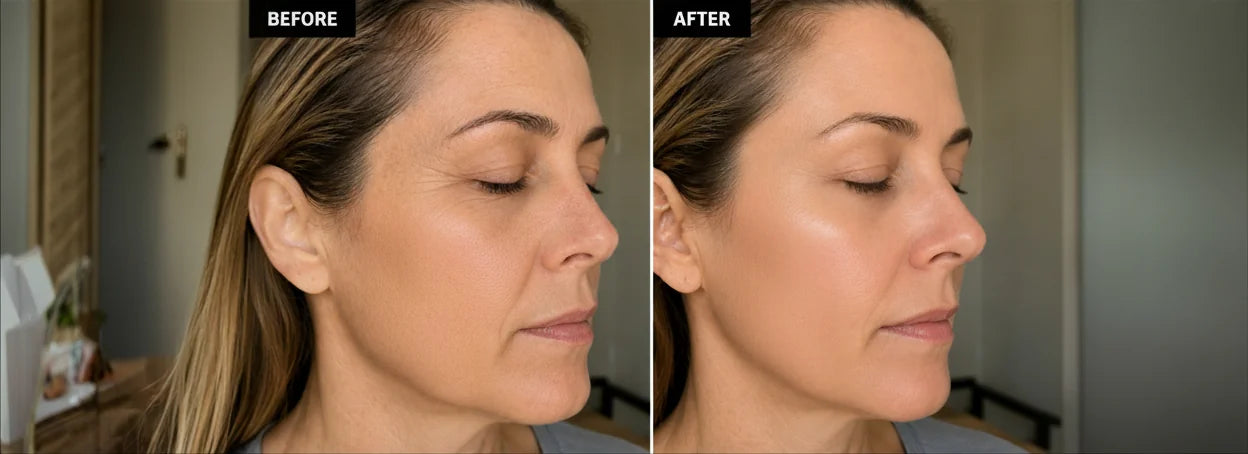
Collagen production peaks in your early twenties. After that, it declines at roughly 1% per year — a slow, compounding process that eventually shows up as fine lines, sagging, and thinner skin. By 50, you've lost about a quarter of the collagen you had at 25.
Red light therapy claims to reverse this. But unlike most skincare claims, this one has clinical trial data behind it.
Red light therapy claims to reverse this. But unlike most skincare claims, this one has clinical trial data behind it.
The mechanism: how light stimulates collagen
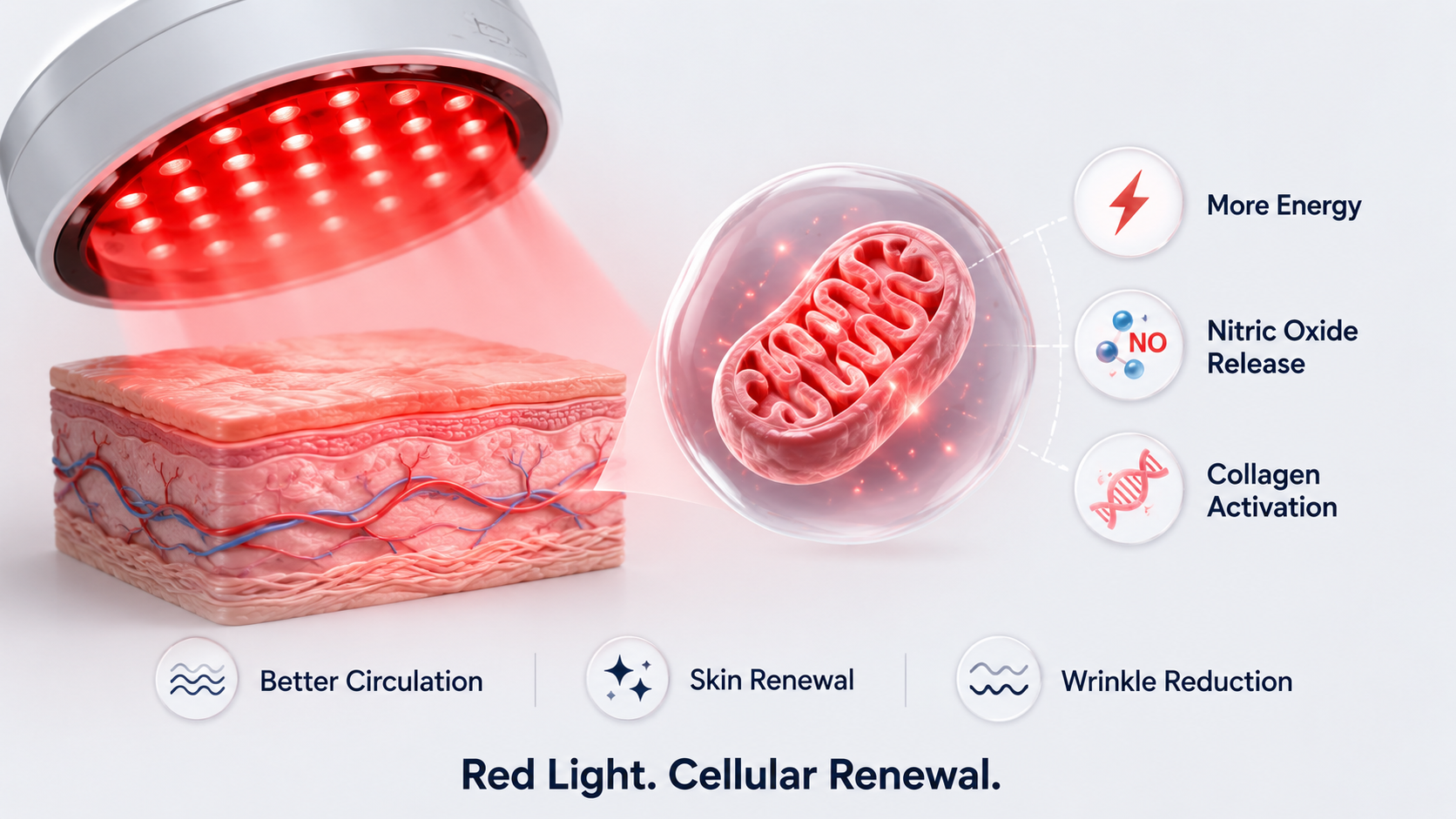
Red light at wavelengths between 630–660nm and near-infrared light at 810–850nm penetrate the skin and are absorbed by mitochondria in dermal fibroblasts — the cells responsible for producing collagen and elastin.
This triggers a process called photobiomodulation: increased ATP production, nitric oxide release, and activation of cellular pathways that upregulate collagen synthesis (Hamblin, 2017). A 2019 study published in the Journal of the American Academy of Dermatology confirmed that low-level red and infrared light significantly increased expression of collagen, elastin, and hyaluronic acid in human skin (JAAD, 2019).
As Dr. Zakia Rahman at Stanford explains, the vasodilation caused by red light is likely the mechanism for wrinkle reduction — widened blood vessels deliver more nutrients to the dermis, supporting the ongoing repair and renewal process.
This triggers a process called photobiomodulation: increased ATP production, nitric oxide release, and activation of cellular pathways that upregulate collagen synthesis (Hamblin, 2017). A 2019 study published in the Journal of the American Academy of Dermatology confirmed that low-level red and infrared light significantly increased expression of collagen, elastin, and hyaluronic acid in human skin (JAAD, 2019).
As Dr. Zakia Rahman at Stanford explains, the vasodilation caused by red light is likely the mechanism for wrinkle reduction — widened blood vessels deliver more nutrients to the dermis, supporting the ongoing repair and renewal process.
The key clinical trial
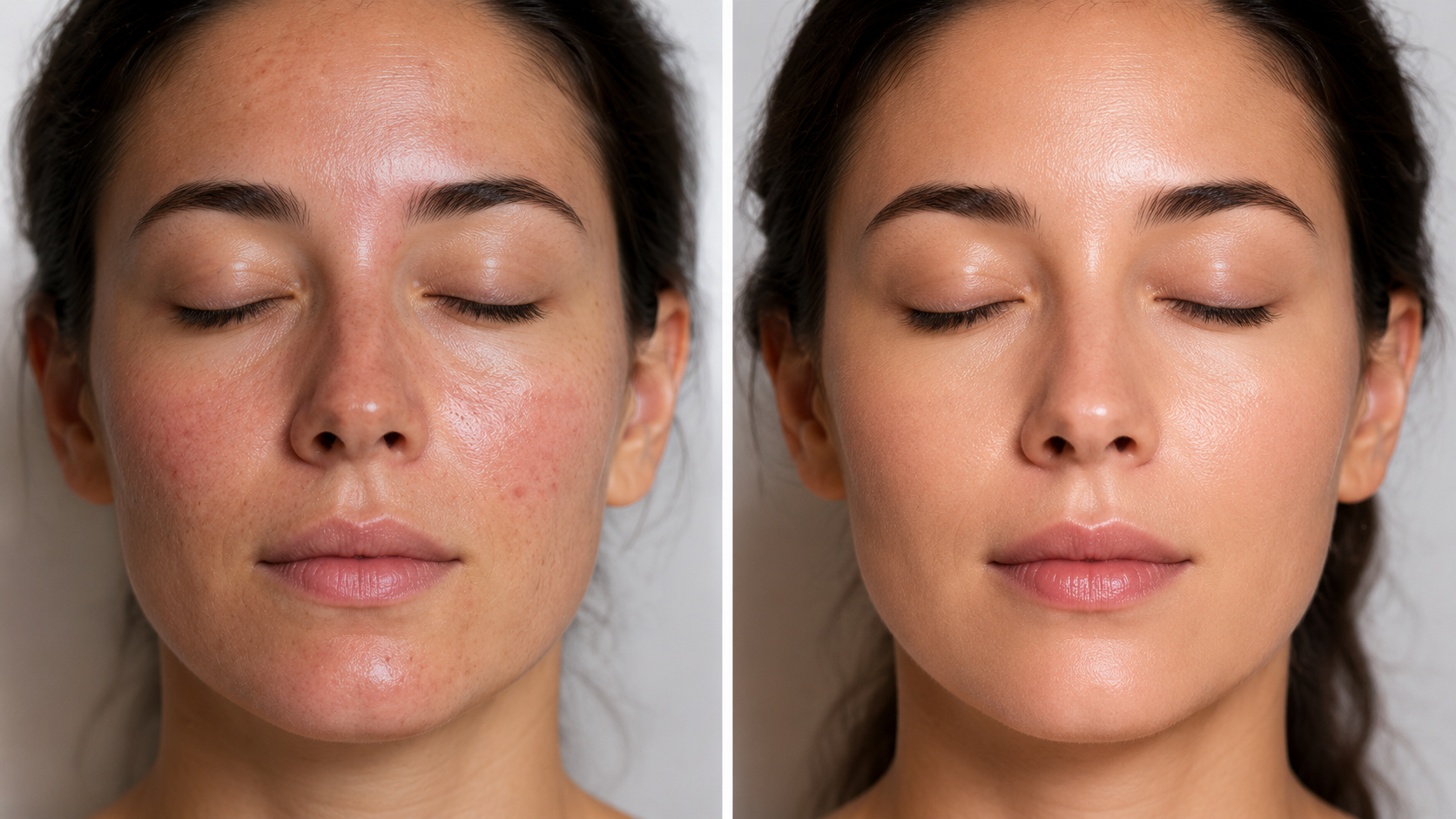
The most-cited study in the field is the Wunsch & Matuschka RCT (2014). 76 participants received treatment with either 633nm red light, a combination of 633nm and 830nm near-infrared light, or placebo. Treatment lasted 30 weeks.
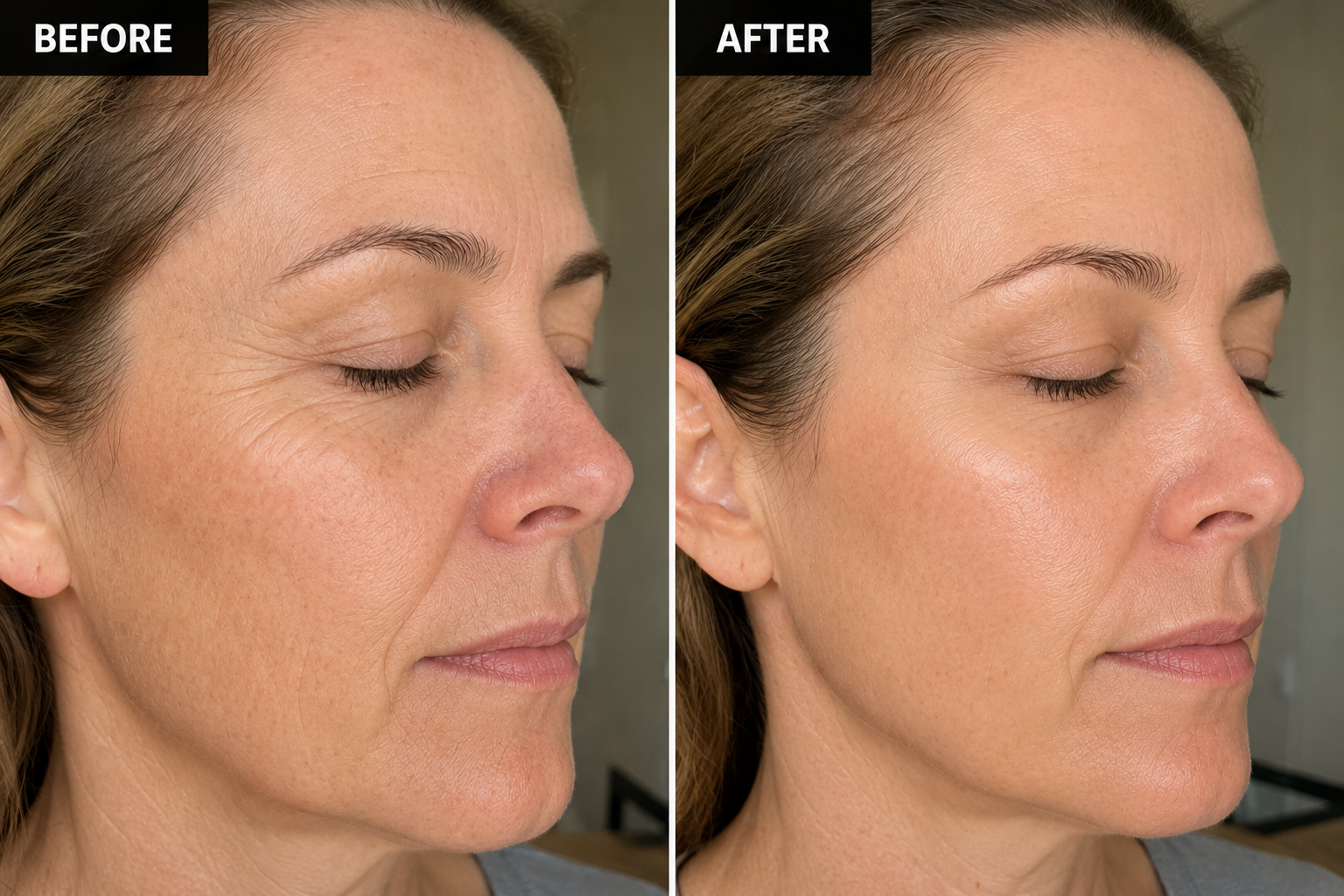
Results: Both treatment groups showed significant improvements compared to control. Blinded clinical evaluation of photographs confirmed visible improvements. The researchers measured intradermal collagen density increase via ultrasound and found meaningful gains in the treatment groups (Wunsch & Matuschka, 2014).
Specific findings: 91% of participants in the treatment group reported improved skin tone. 87% reported reduction in fine lines. These were confirmed by blinded evaluators reviewing photographs — not just self-assessment (BiohackingTested, 2026).
A 2025 review of LLLT for skin rejuvenation further validated these findings, noting that red and near-infrared wavelengths consistently stimulate collagen synthesis and improve skin texture across multiple studies, though optimal treatment protocols still vary (SCIRP, 2025).
Results: Both treatment groups showed significant improvements compared to control. Blinded clinical evaluation of photographs confirmed visible improvements. The researchers measured intradermal collagen density increase via ultrasound and found meaningful gains in the treatment groups (Wunsch & Matuschka, 2014).
Specific findings: 91% of participants in the treatment group reported improved skin tone. 87% reported reduction in fine lines. These were confirmed by blinded evaluators reviewing photographs — not just self-assessment (BiohackingTested, 2026).
A 2025 review of LLLT for skin rejuvenation further validated these findings, noting that red and near-infrared wavelengths consistently stimulate collagen synthesis and improve skin texture across multiple studies, though optimal treatment protocols still vary (SCIRP, 2025).
Safety: is it safe long-term?
A systematic review specifically examining the oncologic safety of photobiomodulation for skin rejuvenation found no evidence linking PBM to cancer risk. Within established parameters, red and near-infrared light enhances proliferation of healthy cells without promoting neoplastic cell growth. The review concluded that PBM is oncologically safe for skin rejuvenation (PMC, 2023).
The Cleveland Clinic classifies red light therapy as safe and non-invasive, noting it uses non-UV, non-thermal light with no known serious side effects when used as directed.
The Cleveland Clinic classifies red light therapy as safe and non-invasive, noting it uses non-UV, non-thermal light with no known serious side effects when used as directed.
Realistic Expectations
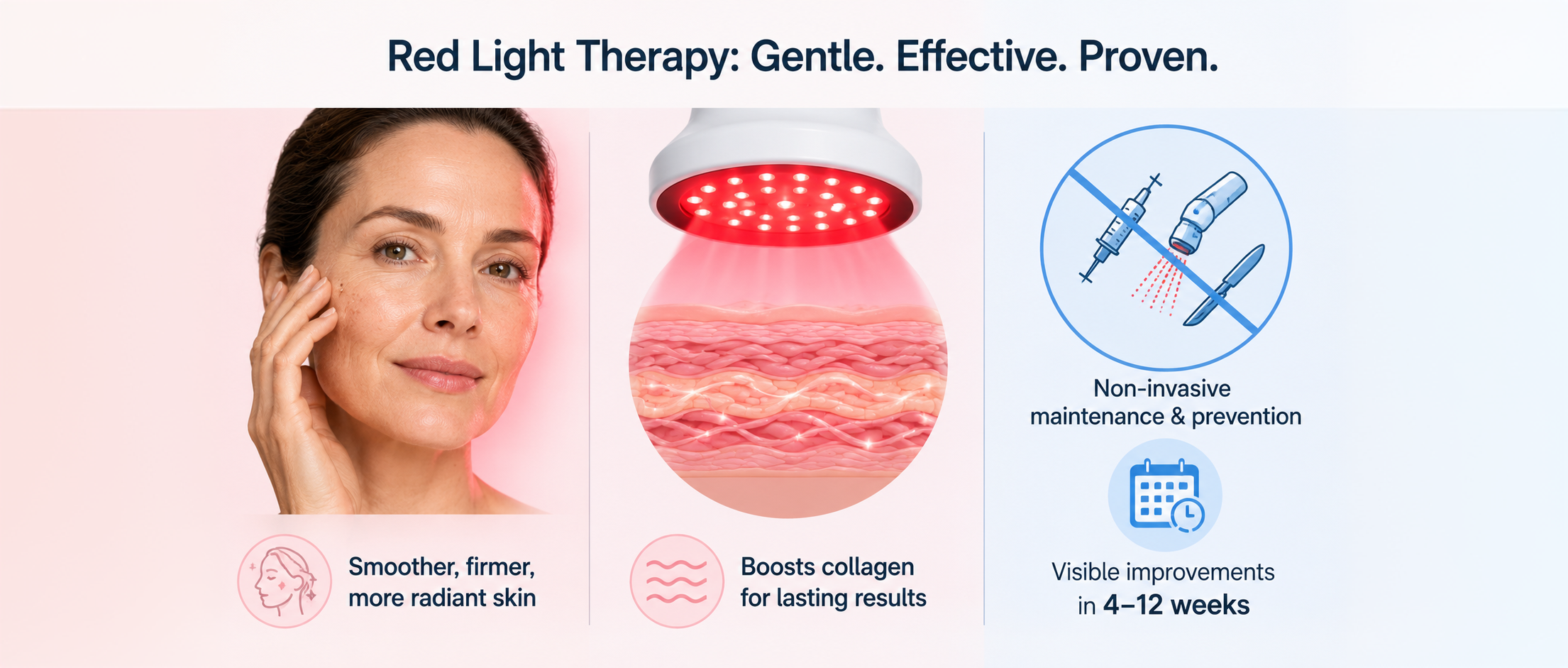
What red light therapy can do: Soften the appearance of fine lines and shallow wrinkles. Improve overall skin texture, tone, and firmness. Increase skin's natural radiance and reduce dullness. Support ongoing collagen production to slow further decline.
What it can't do: Erase deep wrinkles or replace the effects of injectables, laser resurfacing, or surgical procedures. This is a maintenance and prevention tool, not a dramatic intervention.
Timeline: Most clinical trials show measurable improvements at 4–12 weeks of consistent use. The Wunsch & Matuschka study ran for 30 weeks with progressive improvement throughout (Wunsch & Matuschka, 2014).
What it can't do: Erase deep wrinkles or replace the effects of injectables, laser resurfacing, or surgical procedures. This is a maintenance and prevention tool, not a dramatic intervention.
Timeline: Most clinical trials show measurable improvements at 4–12 weeks of consistent use. The Wunsch & Matuschka study ran for 30 weeks with progressive improvement throughout (Wunsch & Matuschka, 2014).
How to use the Red Light Face Mask
The Red Light Face Mask delivers dual wavelengths (630nm + 830nm) with full-face coverage — the same wavelength combination used in the Wunsch & Matuschka trial.
Protocol: 10–20 minutes per session, 3–5 times per week. The mask is hands-free — use it while reading, meditating, or winding down in the evening.
Best practices: Use on clean skin without heavy serums or SPF (these can partially block light). Apply your serums (Vitamin C, niacinamide) after the session — post-treatment permeability may enhance absorption. Always wear SPF during the day — UV exposure degrades the collagen that red light helps rebuild.
For the under-eye area specifically, the Red Light Eye Bag Glasses deliver targeted 630nm treatment to reduce puffiness and fine lines in the most delicate facial skin.
Protocol: 10–20 minutes per session, 3–5 times per week. The mask is hands-free — use it while reading, meditating, or winding down in the evening.
Best practices: Use on clean skin without heavy serums or SPF (these can partially block light). Apply your serums (Vitamin C, niacinamide) after the session — post-treatment permeability may enhance absorption. Always wear SPF during the day — UV exposure degrades the collagen that red light helps rebuild.
For the under-eye area specifically, the Red Light Eye Bag Glasses deliver targeted 630nm treatment to reduce puffiness and fine lines in the most delicate facial skin.
Disclaimer
The content provided in this blog is for informational and educational purposes only. It is not intended to be a substitute for professional medical advice, diagnosis, or treatment.
Recent Posts
Browse Related Products

Join The Red Light Reset
Get science-backed skincare insights, expert guides, and early access to new device launches.
No spam. Just clinically-informed education and member-only benefits