

Home
/
Blogs
/
Science
/
How to Read a Red Light Therapy Study Without a PhD
5 min read
How to Read a Red Light Therapy Study Without a PhD
Every red light therapy brand claims to be "backed by science." Most link to studies. Few explain how to tell a good study from a bad one. If you're spending $200–$500 on a device, you deserve to know what "clinically studied" actually means — and what it doesn't.
This is a quick guide to reading red light therapy research critically, without needing a background in biostatistics.
This is a quick guide to reading red light therapy research critically, without needing a background in biostatistics.
The study hierarchy: not all evidence is equal
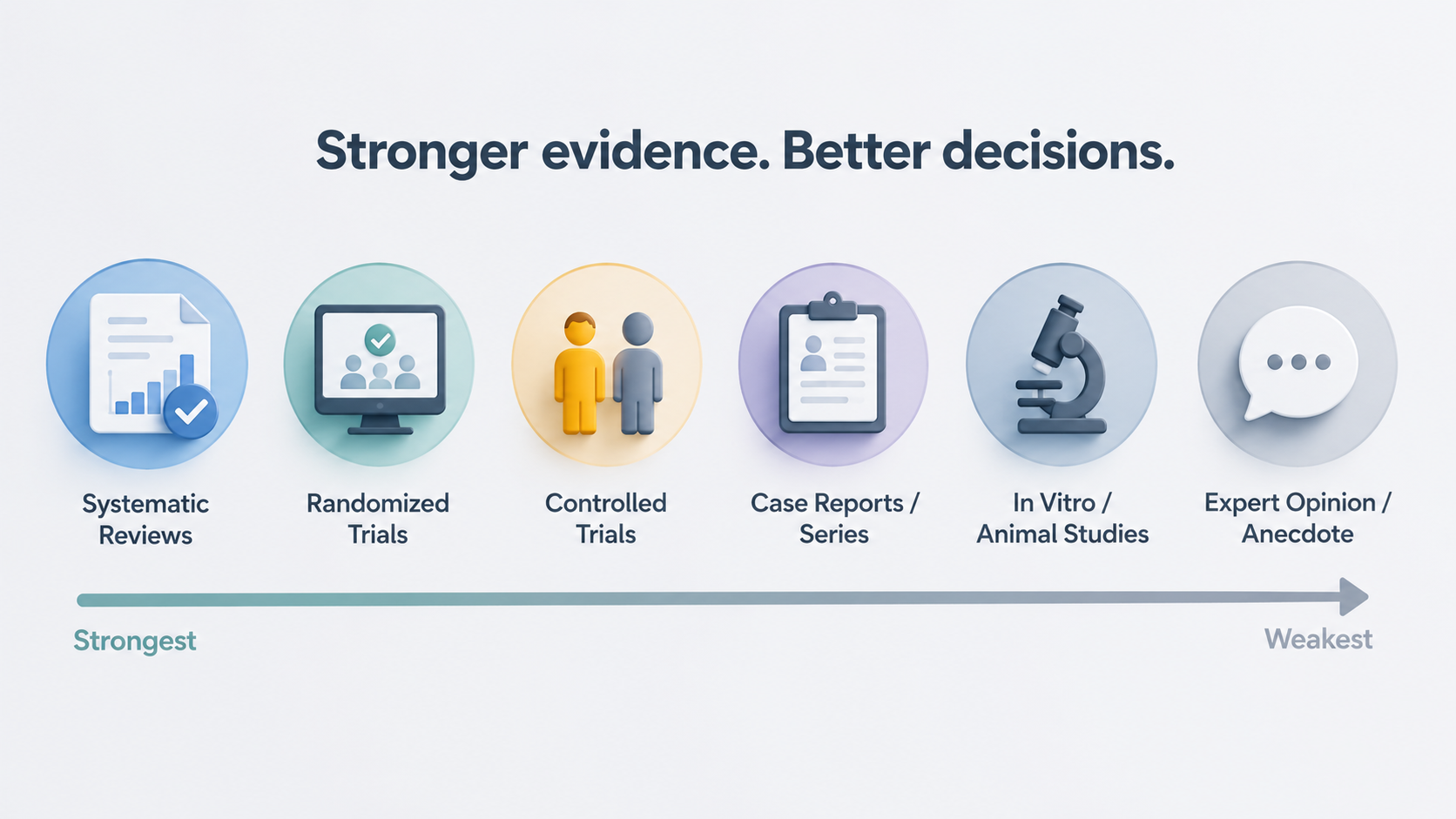
Randomized controlled trials (RCTs): The gold standard. Participants are randomly assigned to either a treatment group or a control/placebo group. Neither the participants nor the evaluators know who's in which group (double-blind). This design controls for placebo effect and bias. The Lanzafame hair growth trials are RCTs — they used sham devices that looked identical but emitted non-therapeutic light.
Systematic reviews and meta-analyses: Researchers pool data from multiple RCTs and analyze the combined results. These are the most reliable evidence summaries because they account for variability across individual studies. The 2025 meta-analysis of FDA-cleared LLLT devices is an example — it synthesized all available RCT data into a single statistical conclusion.
Controlled trials (non-randomized): Treatment vs control, but without random assignment. Slightly weaker than RCTs because selection bias can creep in.
Case series and case reports: "We treated 10 patients and here's what happened." Useful for generating hypotheses but can't prove causation. No control group, no randomization.
In vitro studies (cell/tissue cultures): Cells in a dish exposed to light. Useful for understanding mechanisms (e.g., the RNA sequencing study on hair follicles) but doesn't tell you what happens in a living human body.
Animal studies: Mice, rats, etc. More relevant than in vitro but animal biology doesn't always translate to humans.
Expert opinion / anecdote: The weakest evidence. "Dr. X recommends it" or "influencer Y saw results" is not clinical evidence.
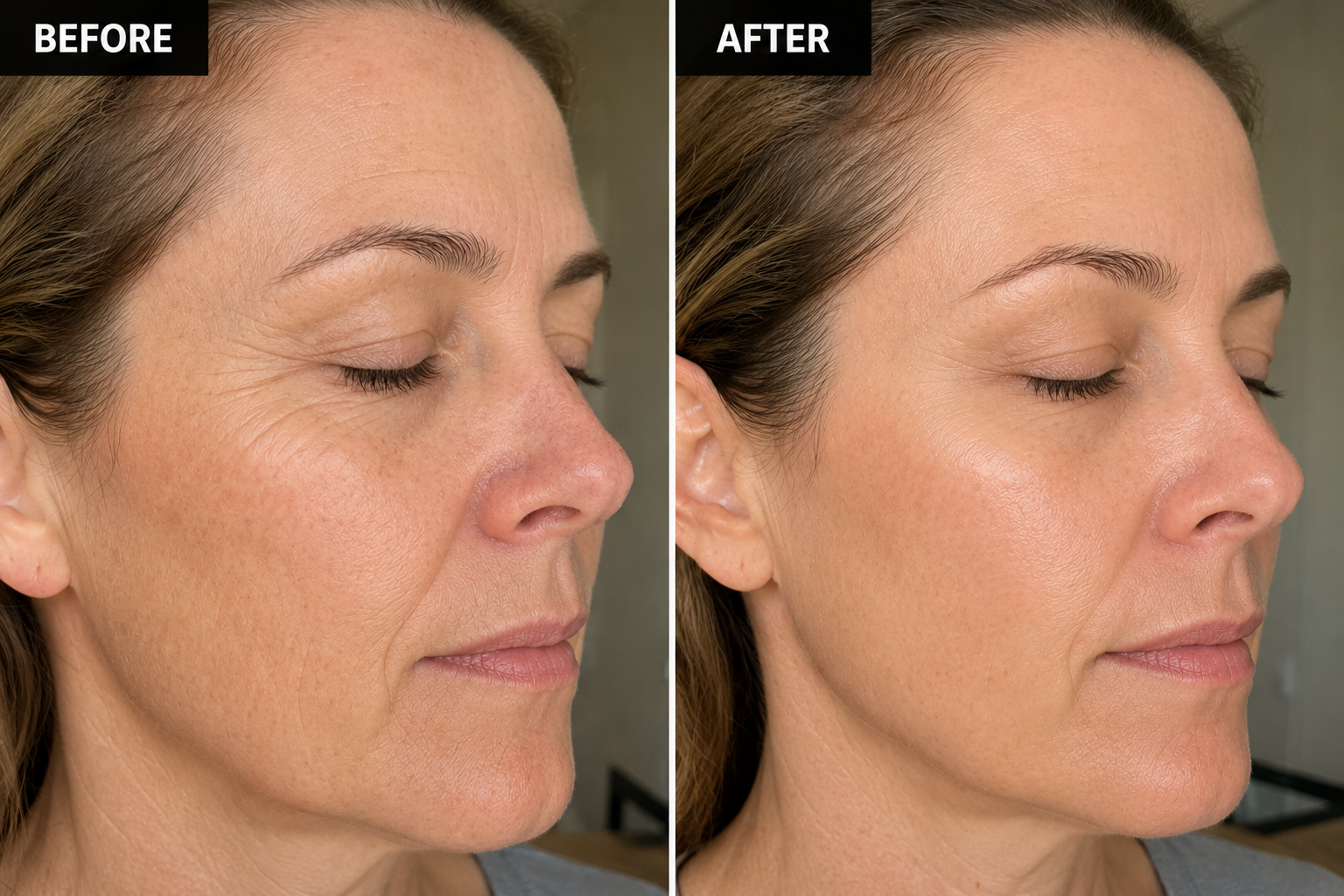
When a brand says "clinically proven," ask: proven by what? An RCT with a sham control? Or a blog post with before-and-after photos?
Systematic reviews and meta-analyses: Researchers pool data from multiple RCTs and analyze the combined results. These are the most reliable evidence summaries because they account for variability across individual studies. The 2025 meta-analysis of FDA-cleared LLLT devices is an example — it synthesized all available RCT data into a single statistical conclusion.
Controlled trials (non-randomized): Treatment vs control, but without random assignment. Slightly weaker than RCTs because selection bias can creep in.
Case series and case reports: "We treated 10 patients and here's what happened." Useful for generating hypotheses but can't prove causation. No control group, no randomization.
In vitro studies (cell/tissue cultures): Cells in a dish exposed to light. Useful for understanding mechanisms (e.g., the RNA sequencing study on hair follicles) but doesn't tell you what happens in a living human body.
Animal studies: Mice, rats, etc. More relevant than in vitro but animal biology doesn't always translate to humans.
Expert opinion / anecdote: The weakest evidence. "Dr. X recommends it" or "influencer Y saw results" is not clinical evidence.
When a brand says "clinically proven," ask: proven by what? An RCT with a sham control? Or a blog post with before-and-after photos?
Red flags in weak studies
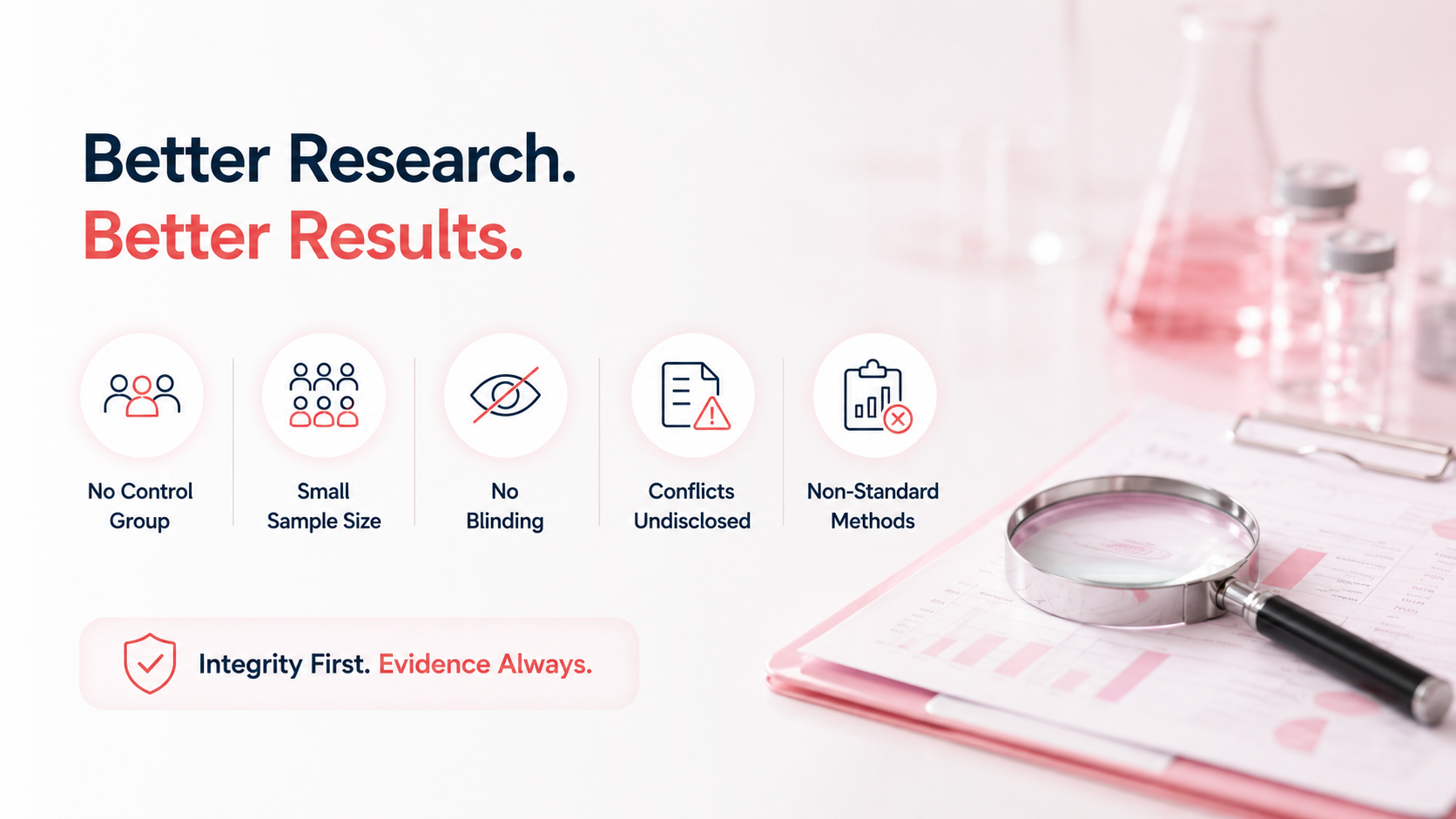
No control group: If everyone in the study received treatment and no one received a placebo, you can't separate the real effect from the placebo effect. This is surprisingly common in wellness research.
Tiny sample size: A study with 8 participants can't reliably detect an effect. Most well-powered hair or skin studies need 30–50+ participants per group. The Lanzafame 2013 trial had 44 participants — not enormous, but sufficient for the effect size observed.
No blinding: If participants know they're getting the real treatment, their subjective assessments (like "my skin feels smoother") are unreliable. Good studies use sham devices and blinded evaluators. The Wunsch & Matuschka trial used blinded clinical evaluation of photographs — the evaluators didn't know which participants received treatment.
Conflict of interest without disclosure: If the study was funded by the device manufacturer and doesn't disclose that, be cautious. Disclosed industry funding isn't automatically disqualifying — many legitimate studies are industry-funded — but undisclosed conflicts are a red flag.
"Clinically proven" without a citation: If a brand claims "clinically proven results" on their website but doesn't link to the specific study, or the study is of a different device, or the study is unpublished — that's marketing, not evidence.
Results measured by non-standard methods: Hair growth studies should measure hair count per square centimeter using standardized photography. Skin studies should use objective measures like ultrasound collagen density or blinded photo evaluation. "Patient satisfaction" alone isn't sufficient.
Tiny sample size: A study with 8 participants can't reliably detect an effect. Most well-powered hair or skin studies need 30–50+ participants per group. The Lanzafame 2013 trial had 44 participants — not enormous, but sufficient for the effect size observed.
No blinding: If participants know they're getting the real treatment, their subjective assessments (like "my skin feels smoother") are unreliable. Good studies use sham devices and blinded evaluators. The Wunsch & Matuschka trial used blinded clinical evaluation of photographs — the evaluators didn't know which participants received treatment.
Conflict of interest without disclosure: If the study was funded by the device manufacturer and doesn't disclose that, be cautious. Disclosed industry funding isn't automatically disqualifying — many legitimate studies are industry-funded — but undisclosed conflicts are a red flag.
"Clinically proven" without a citation: If a brand claims "clinically proven results" on their website but doesn't link to the specific study, or the study is of a different device, or the study is unpublished — that's marketing, not evidence.
Results measured by non-standard methods: Hair growth studies should measure hair count per square centimeter using standardized photography. Skin studies should use objective measures like ultrasound collagen density or blinded photo evaluation. "Patient satisfaction" alone isn't sufficient.
How to check a study yourself
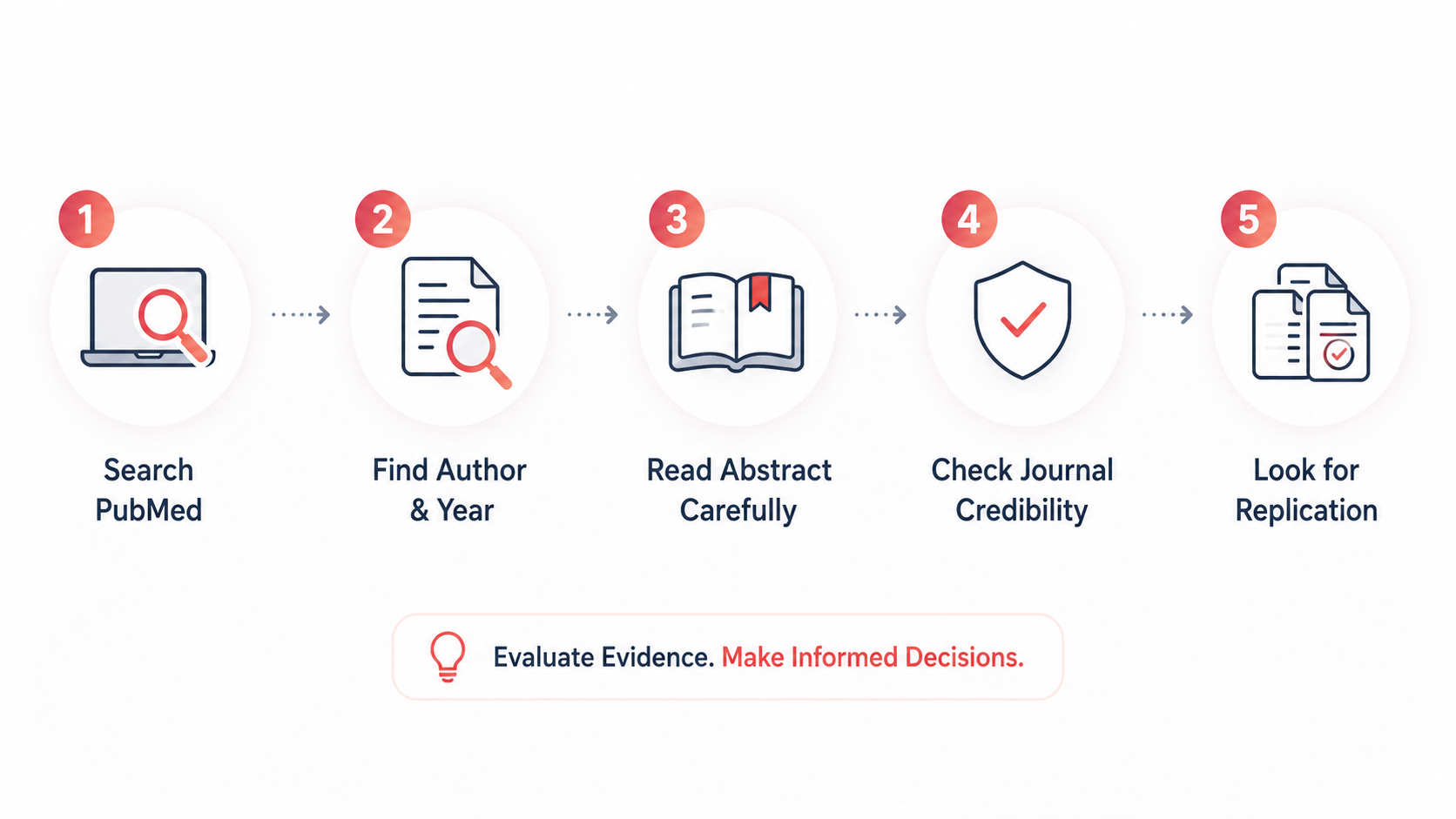
Step 1: Go to PubMed: It's free and searchable by anyone.
Step 2: Search for the author name and year cited by the brand. If they cite "Lanzafame 2013," search "Lanzafame LLLT hair" and you'll find the study.
Step 3: Read the abstract. Look for: study design (RCT, controlled trial, case series), sample size, intervention details (wavelength, duration, frequency), primary outcome measure, and results.
Step 4: Check the journal. Is it peer-reviewed? Journals like Lasers in Surgery and Medicine, JAAD, and Photomedicine and Laser Surgery are legitimate. Be cautious of predatory journals with no editorial standards.
Step 5: Look for replication. Has more than one research group found similar results? The Harvard/Wellman Center review is valuable precisely because it synthesizes findings from multiple independent research teams.
Step 2: Search for the author name and year cited by the brand. If they cite "Lanzafame 2013," search "Lanzafame LLLT hair" and you'll find the study.
Step 3: Read the abstract. Look for: study design (RCT, controlled trial, case series), sample size, intervention details (wavelength, duration, frequency), primary outcome measure, and results.
Step 4: Check the journal. Is it peer-reviewed? Journals like Lasers in Surgery and Medicine, JAAD, and Photomedicine and Laser Surgery are legitimate. Be cautious of predatory journals with no editorial standards.
Step 5: Look for replication. Has more than one research group found similar results? The Harvard/Wellman Center review is valuable precisely because it synthesizes findings from multiple independent research teams.
What "FDA-cleared" actually means
A common point of confusion. The American Hair Loss Association explains the distinction clearly:
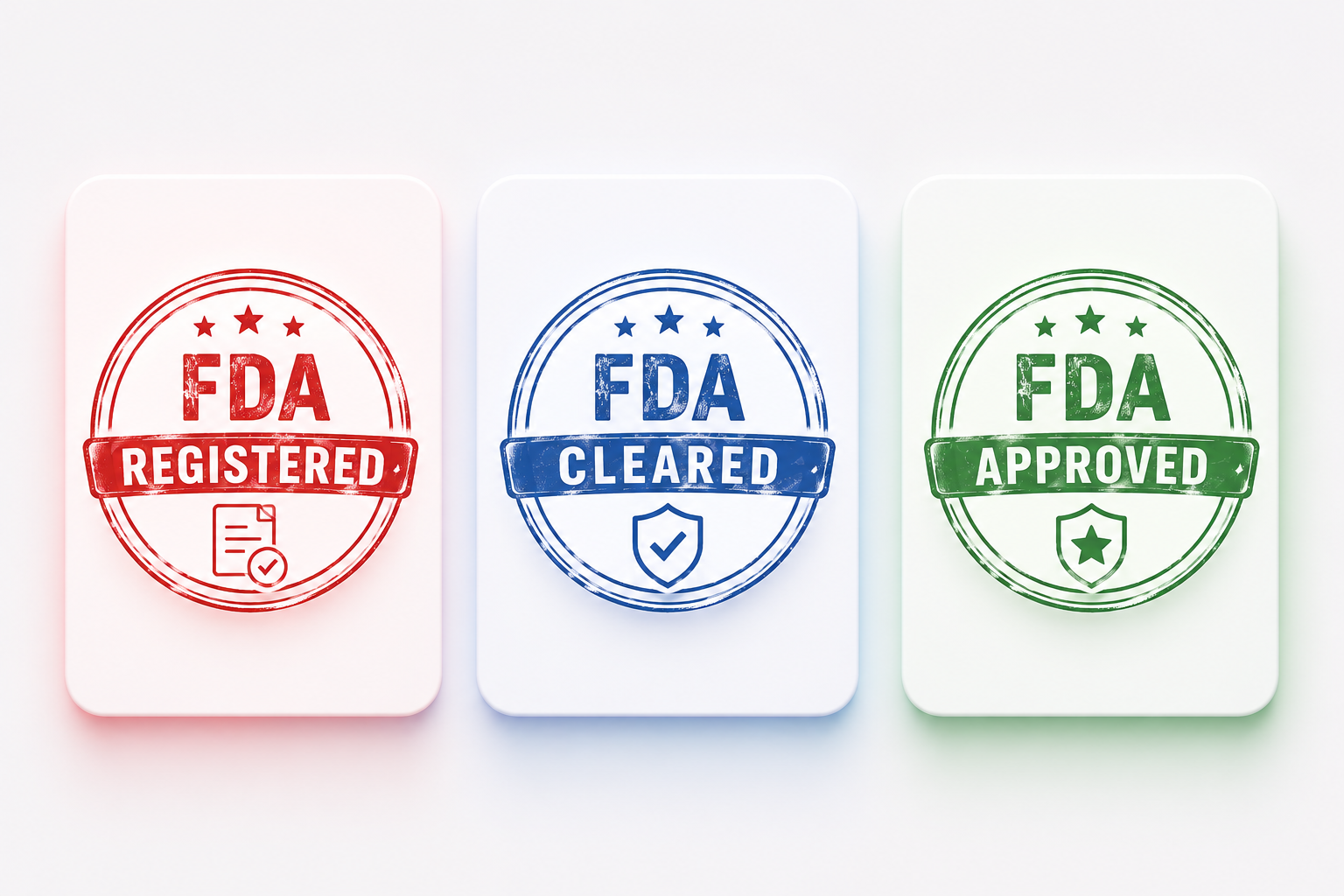
FDA-approved: Applies to drugs and high-risk medical devices. Requires extensive clinical trials proving safety and efficacy. Red light therapy devices are not FDA-approved.
FDA-cleared (510(k)): Applies to low-to-moderate risk medical devices. The manufacturer demonstrates that their device is substantially equivalent to an already-cleared device and submits safety data. Multiple LLLT hair growth devices have received 510(k) clearance.
FDA-registered: Simply means the manufacturer has registered their establishment and listed their device with the FDA. It does not imply any review of safety or efficacy. Many consumer devices are "FDA-registered" — this is a much lower bar than clearance.
You can verify any device's clearance status in the FDA's 510(k) database.
FDA-approved: Applies to drugs and high-risk medical devices. Requires extensive clinical trials proving safety and efficacy. Red light therapy devices are not FDA-approved.
FDA-cleared (510(k)): Applies to low-to-moderate risk medical devices. The manufacturer demonstrates that their device is substantially equivalent to an already-cleared device and submits safety data. Multiple LLLT hair growth devices have received 510(k) clearance.
FDA-registered: Simply means the manufacturer has registered their establishment and listed their device with the FDA. It does not imply any review of safety or efficacy. Many consumer devices are "FDA-registered" — this is a much lower bar than clearance.
You can verify any device's clearance status in the FDA's 510(k) database.
Disclaimer
The content provided in this blog is for informational and educational purposes only. It is not intended to be a substitute for professional medical advice, diagnosis, or treatment.
Recent Posts

Browse Related Products

Join The Red Light Reset
Get science-backed skincare insights, expert guides, and early access to new device launches.
No spam. Just clinically-informed education and member-only benefits