

Home
/
Blogs
/
Recovery
/
How Athletes Use Red Light Therapy to Recover Faster
6 min read
How Athletes Use Red Light Therapy to Recover Faster
If you follow professional sports, you've probably noticed red light therapy panels showing up in locker rooms, training facilities, and athlete recovery routines. This isn't a trend — it's backed by a growing body of clinical evidence on photobiomodulation for exercise recovery.
Here's what the research says and how to apply it.
Here's what the research says and how to apply it.
Why muscles need more than rest
After intense exercise, muscles undergo microtrauma — small tears in muscle fibers that trigger inflammation and repair. This is normal and necessary for adaptation. But the speed of that repair process determines how quickly you can train again at full intensity.
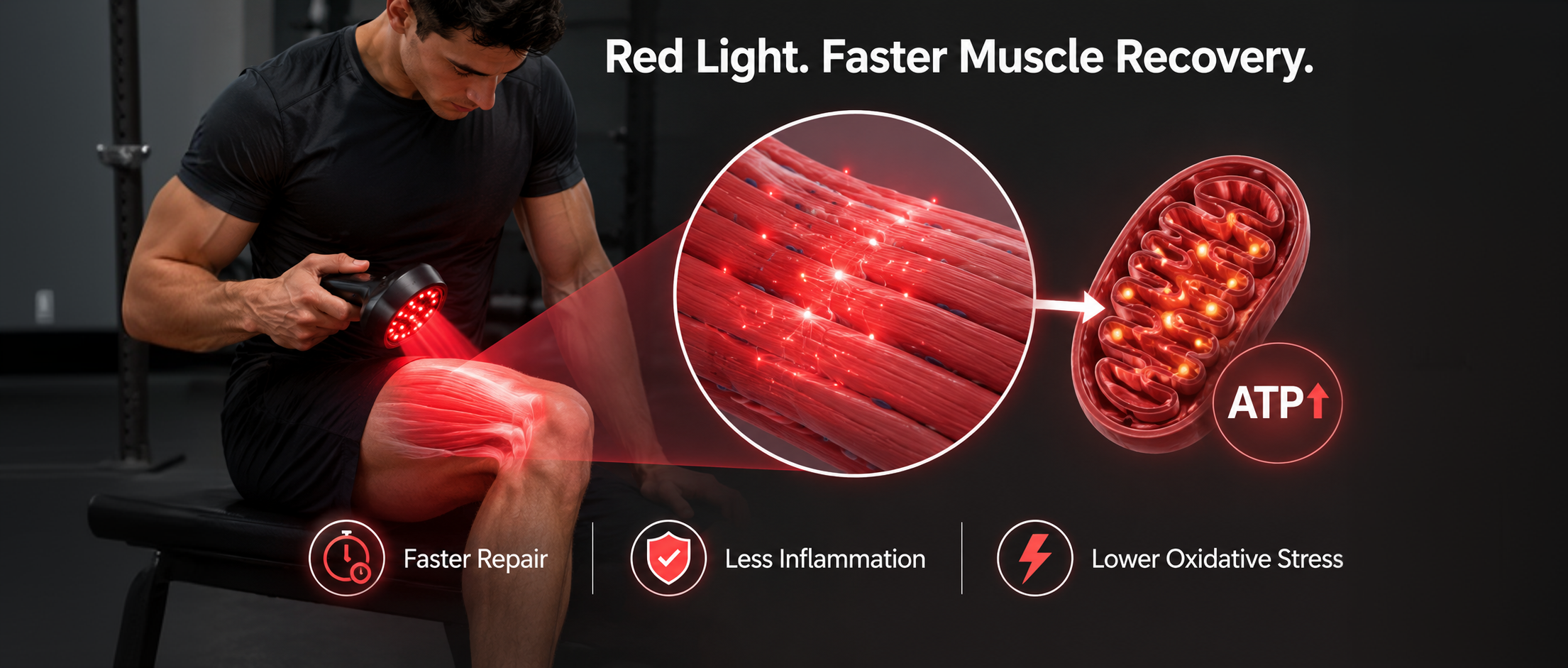
The bottleneck is cellular energy. Damaged muscle cells need ATP (adenosine triphosphate) to fuel the repair process. Red and near-infrared light at 630–850nm wavelengths penetrate tissue and are absorbed by cytochrome c oxidase in the mitochondria, directly increasing ATP production (Hamblin, 2017).
The result: faster cellular repair, reduced inflammation, and decreased oxidative stress in the treated tissue.
The bottleneck is cellular energy. Damaged muscle cells need ATP (adenosine triphosphate) to fuel the repair process. Red and near-infrared light at 630–850nm wavelengths penetrate tissue and are absorbed by cytochrome c oxidase in the mitochondria, directly increasing ATP production (Hamblin, 2017).
The result: faster cellular repair, reduced inflammation, and decreased oxidative stress in the treated tissue.
What the clinical evidence shows
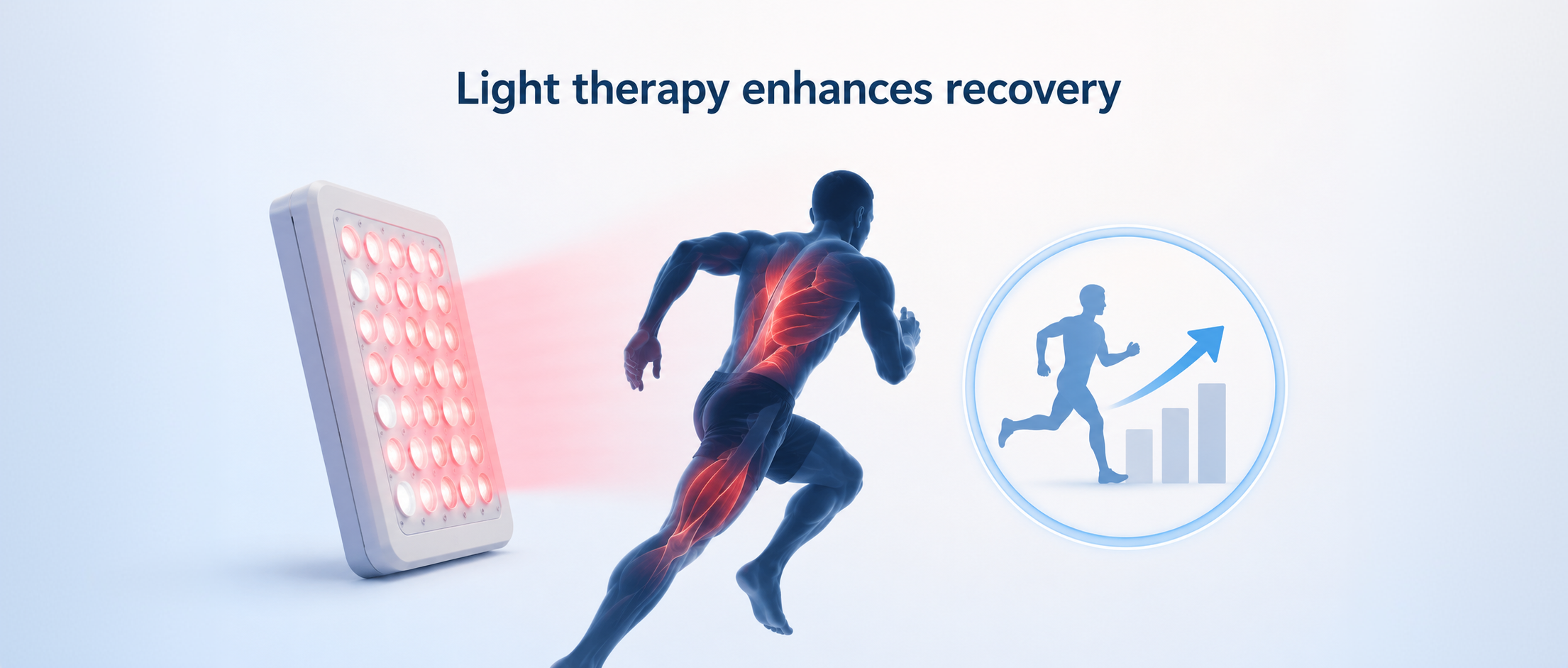
Ferraresi et al., 2012 — Systematic review: This comprehensive review examined all available evidence on LLLT for skeletal muscle performance and recovery. The analysis found consistent evidence that photobiomodulation applied before or after exercise reduced markers of muscle damage (creatine kinase, lactate) and decreased delayed-onset muscle soreness (DOMS) (Ferraresi et al., 2012).
Leal-Junior et al., 2015 — Performance and recovery: A review of photobiomodulation therapy for exercise performance found that LLLT/LED therapy applied before exercise improved muscular performance and accelerated post-exercise recovery. The mechanisms included increased mitochondrial function, reduced fatigue markers, and attenuated inflammation (Leal-Junior et al., 2015).
Cotler et al., 2015 — Musculoskeletal pain: A review of LLLT for musculoskeletal pain conditions found evidence supporting its use for reducing pain and improving function across multiple conditions, including exercise-related soreness and joint discomfort (Cotler et al., 2015).
The anti-inflammatory mechanism: Hamblin's 2017 review detailed how photobiomodulation reduces pro-inflammatory cytokines (IL-1β, IL-6, TNF-α) while increasing anti-inflammatory mediators — essentially shifting the body's inflammatory response toward faster resolution (Hamblin, 2017).
Leal-Junior et al., 2015 — Performance and recovery: A review of photobiomodulation therapy for exercise performance found that LLLT/LED therapy applied before exercise improved muscular performance and accelerated post-exercise recovery. The mechanisms included increased mitochondrial function, reduced fatigue markers, and attenuated inflammation (Leal-Junior et al., 2015).
Cotler et al., 2015 — Musculoskeletal pain: A review of LLLT for musculoskeletal pain conditions found evidence supporting its use for reducing pain and improving function across multiple conditions, including exercise-related soreness and joint discomfort (Cotler et al., 2015).
The anti-inflammatory mechanism: Hamblin's 2017 review detailed how photobiomodulation reduces pro-inflammatory cytokines (IL-1β, IL-6, TNF-α) while increasing anti-inflammatory mediators — essentially shifting the body's inflammatory response toward faster resolution (Hamblin, 2017).
Pre-workout vs post-workout: when to use it
The research supports both, with slightly different mechanisms:
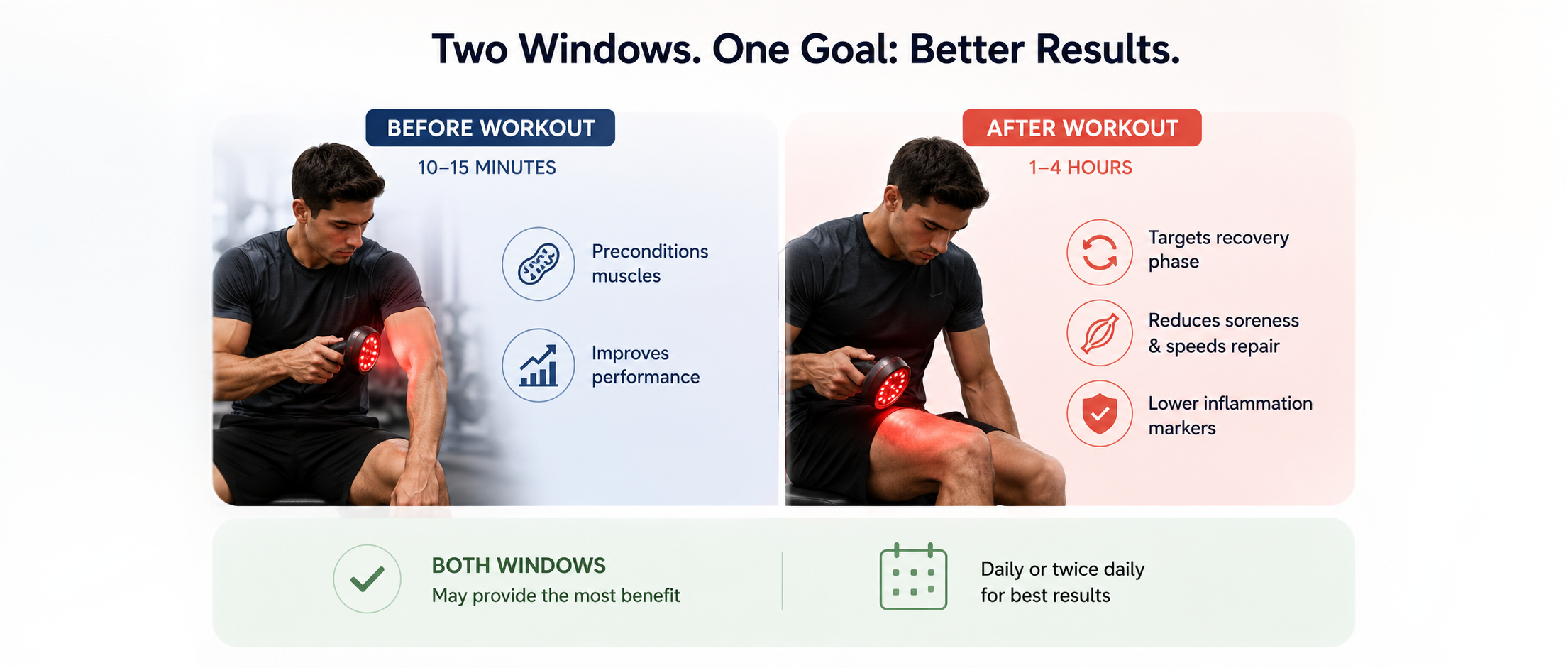
Pre-workout application (10–15 minutes before training): Appears to precondition muscle tissue, increasing mitochondrial readiness and potentially improving performance output. The Leal-Junior review found measurable improvements in time-to-fatigue and peak force when LLLT was applied before exercise (Leal-Junior et al., 2015).
Post-workout application (within 1–4 hours after training): Targets the recovery phase directly. Reduces DOMS severity, accelerates clearance of metabolic waste products, and speeds the inflammatory-to-repair transition. Most studies showing reduced creatine kinase levels used post-exercise application.
Both: If you can only pick one, post-workout has more consistent evidence for recovery specifically. If you train daily or twice daily, using it in both windows may provide the most benefit.
Pre-workout application (10–15 minutes before training): Appears to precondition muscle tissue, increasing mitochondrial readiness and potentially improving performance output. The Leal-Junior review found measurable improvements in time-to-fatigue and peak force when LLLT was applied before exercise (Leal-Junior et al., 2015).
Post-workout application (within 1–4 hours after training): Targets the recovery phase directly. Reduces DOMS severity, accelerates clearance of metabolic waste products, and speeds the inflammatory-to-repair transition. Most studies showing reduced creatine kinase levels used post-exercise application.
Both: If you can only pick one, post-workout has more consistent evidence for recovery specifically. If you train daily or twice daily, using it in both windows may provide the most benefit.
How to build your recovery protocol
The Red Light Panel delivers high-power 630nm + 850nm LEDs across a large treatment area — necessary for covering major muscle groups (quads, back, shoulders) rather than just a small spot.
Post-training protocol:
Position the panel 6–12 inches from the target area
Treat each major muscle group used in the session for 10–15 minutes
Total session: 20–30 minutes if treating multiple areas
Use within 1–4 hours of training for best results
Recovery day protocol:
Full-body exposure for 15–20 minutes
Focus on areas with residual soreness
Combine with gentle mobility work or stretching
Building a complete recovery stack:
Post-workout: Red Light Panel for major muscle groups
Targeted joints: the Red Light Scalp Massager can also be used on smaller areas like elbows, wrists, and ankles (it's a handheld 630nm + 850nm device)
Sleep optimization: adequate sleep remains the single most important recovery factor — red light therapy supplements it but doesn't replace it
Post-training protocol:
Position the panel 6–12 inches from the target area
Treat each major muscle group used in the session for 10–15 minutes
Total session: 20–30 minutes if treating multiple areas
Use within 1–4 hours of training for best results
Recovery day protocol:
Full-body exposure for 15–20 minutes
Focus on areas with residual soreness
Combine with gentle mobility work or stretching
Building a complete recovery stack:
Post-workout: Red Light Panel for major muscle groups
Targeted joints: the Red Light Scalp Massager can also be used on smaller areas like elbows, wrists, and ankles (it's a handheld 630nm + 850nm device)
Sleep optimization: adequate sleep remains the single most important recovery factor — red light therapy supplements it but doesn't replace it
Who benefits most
Strength and power athletes: Heavy compound lifts cause significant muscle damage. LLLT can accelerate recovery between sessions, potentially allowing higher training frequency.
Endurance athletes: Long runs, cycling, and swimming create cumulative fatigue and inflammation. Regular LLLT use may reduce overtraining risk and improve week-over-week recovery.
Weekend warriors and recreational athletes: If you train 3–5 days per week and soreness limits your consistency, LLLT can meaningfully reduce the recovery tax on your schedule.
Anyone over 35: Recovery capacity naturally declines with age. The mitochondrial support from photobiomodulation may be most valuable for older athletes whose cellular energy production is already declining.
Endurance athletes: Long runs, cycling, and swimming create cumulative fatigue and inflammation. Regular LLLT use may reduce overtraining risk and improve week-over-week recovery.
Weekend warriors and recreational athletes: If you train 3–5 days per week and soreness limits your consistency, LLLT can meaningfully reduce the recovery tax on your schedule.
Anyone over 35: Recovery capacity naturally declines with age. The mitochondrial support from photobiomodulation may be most valuable for older athletes whose cellular energy production is already declining.
Disclaimer
The content provided in this blog is for informational and educational purposes only. It is not intended to be a substitute for professional medical advice, diagnosis, or treatment.
Recent Posts


Browse Related Products

Join The Red Light Reset
Get science-backed skincare insights, expert guides, and early access to new device launches.
No spam. Just clinically-informed education and member-only benefits